
Recently while completing a meta review of woman and fitness a painfully obvious trend emerged. We considered generally available information across a wide swath of the industry. As well we dug deep with female clients present and past and what they run into discussion and knowledge base wise amongst their female contacts.
As many of you might have suspected girls and woman have been grossly propagandized and used as an almost slave like source of income in the looks, fitness and health world. Now in the wake of “social media influencers” the power of persuasion has exploded.
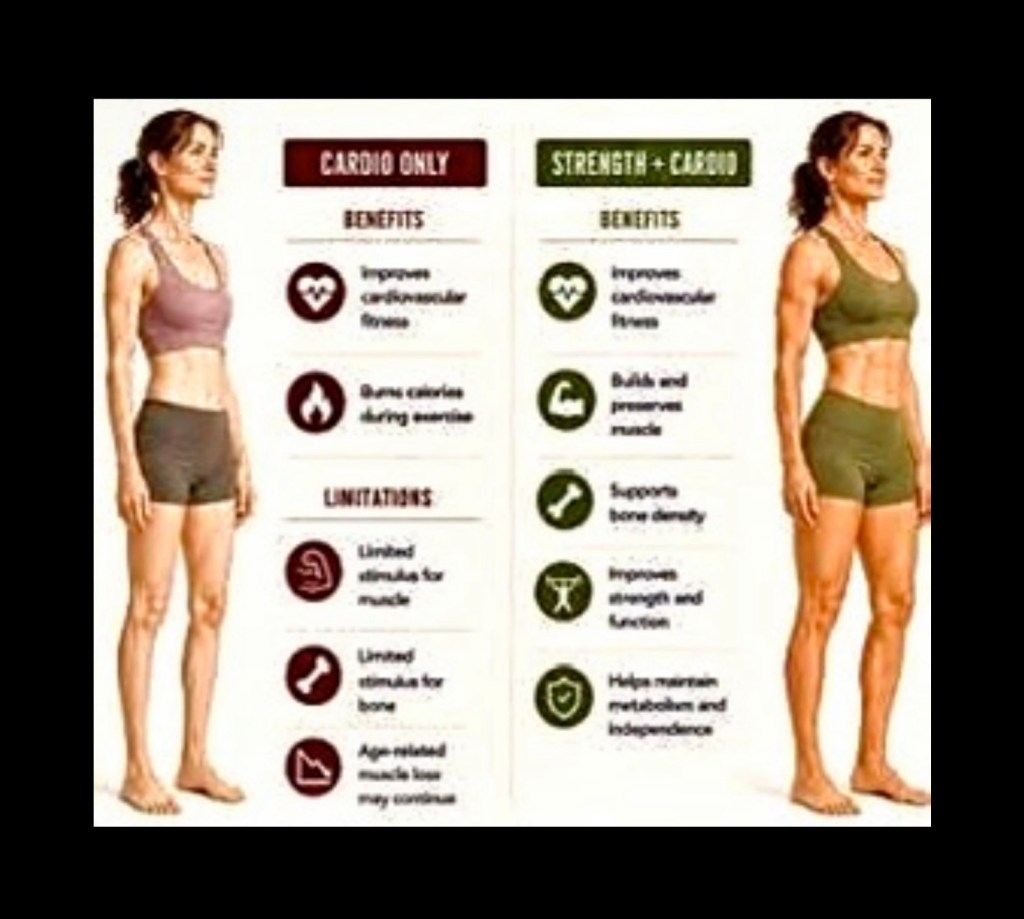
We don’t claim to be able to contribute much to changing this state of affairs but we do claim to offer an antidote. That is to say we don’t just think strength training is an alternative we know it is the actual solution. Providing a partial solution to females who have physical needs is actually worse than no solution. False promises cause even more and often deeper problems. Kooky diet fads and fat burning fitness classes make matters worse when you’re not strong. Men have a bit of a muscle buffer but females metabolisms are far more complex.
Be strong….don’t fall for predatory marketing,
Andrew and Tierney


An interesting perspective, Andrew and Tierney. I think there is considerable merit in questioning how the fitness industry markets health and wellness to women, particularly when the emphasis is placed on appearance rather than physical capability.
Interestingly, a 2024 study published in the Journal of the American College of Cardiology, involving more than 412,000 adults, revealed a striking disparity:
● Regular strength training was associated with a 19% lower risk of all-cause mortality in women, compared with 11% in men.
● Cardiovascular mortality was 30% lower among women who regularly engaged in strength training, compared with 11% among men.
● Yet only approximately 20% of women reported regular strength training, compared with 28% of men.
This presents an intriguing paradox: women participate less in an activity from which they may derive comparatively greater health benefits.
Beyond longevity, resistance training plays an important role in preserving muscle mass, bone density, metabolic health and functional independence, particularly during and after menopause.
While I would hesitate to characterize strength training as the singular solution, it clearly deserves a more prominent place within a comprehensive approach to health and fitness.
Perhaps the fitness industry needs to reconsider its metrics of success. Rather than emphasizing how much weight a woman can lose, why not emphasize how much physical capacity, independence and quality of life she can gain?
The objective should not necessarily be to occupy less space in the world, but to remain capable of engaging fully with it for as long as possible.
Source: Ji et al., Journal of the American College of Cardiology, 2024; 83(8):783–793.
https://doi.org/10.1016/j.jacc.2023.12.019